
In a comprehensive benchmarking study performed in late 2025 by the University of Alabama, several different image similarity methods were evaluated to see how they compare against one another. Included in the study were embedding-based methods using vision transformers (ViT, SWIN, DINOv2), keypoint-based approaches using feature descriptors (SIFT, ORB), and DejaVuAI’s own pattern-matching algorithm. Of the six methods, results indicate clear advantages of a pattern-matching approach, outperforming the others in a number of key areas.
The study spanned across 7 datasets representing real-world scenarios, testing each method’s ability to locate a given query image among 1,000 sample images. Within each dataset was a “ground truth” image from which the query was derived. The evaluation metric (Recall@k) details whether the ground truth image appears in the top-k retrieved results. Several transformations were also applied to test each method’s robustness in matching across invariance, including geometric (rotation, flip), photometric (brightness, contrast, hue, saturation), degradation (gaussian noise, blur, JPG compression), and segmentation.
Pattern Matching Compared to Other Methods
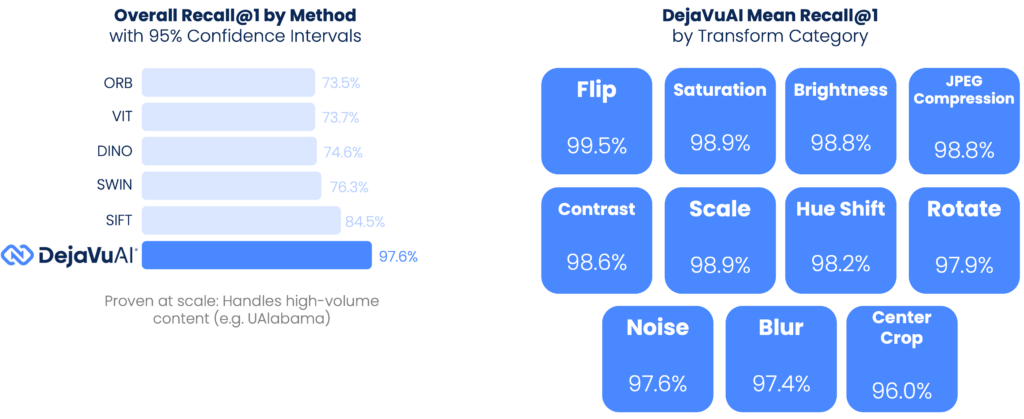
Strong flip invariance: ~99.5% Recall@1, comparable to embeddings and outperforming keypoint methods.
Excellent rotation handling: ~97-98% Recall@1, comparable to keypoints and outperforming embeddings.
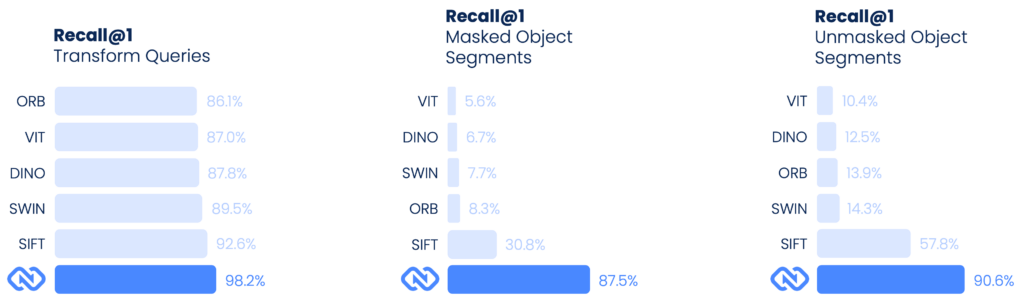
Robust object segment matching: 87-91% Recall@1, substantially outperforming both keypoints and embeddings.
Key Findings
Pattern-matching achieves highest overall performance with 97.6% Recall@1.
Pattern-matching excels at detecting through flip and rotation.
Pattern-matching has a substantial object segment advantage.
- 55.5 percentage points better than SWIN
- 24.2 percentage points better than SIFT
The evaluation shows that pattern-matching significantly demonstrates best overall performance over different image comparison paradigms, matching the best metrics and significantly outperforming the rest. What does this mean for real world applications? Most methods may yield effective results in a given niche, but lack comprehensive capabilities on their own. As databases scale to the billions, choice becomes critical when balancing accuracy, computational efficiency, speed, and other factors.
This study paints a thorough picture of the advantages of pattern-matching as an image similarity paradigm—a testament to its place in the world of computer vision solutions. But we aren’t stopping there. As the technology continues to evolve with our ClearSeek™ platform, DejaVuAI is committed to further improving our solutions, shattering expectations, and delivering the absolute best for our partners.